
Pediatric Dental Health
Baby Lip Tie: Signs, Feeding Impact, and When to Have It Evaluated
What a lip tie actually is, the feeding patterns parents tend to notice first, and an honest look at when a release makes sense — and when it isn’t needed.
For general education only, not medical or dental advice. Please read the full disclaimer at the end of this article.
By Inspire Dental Wellness · ~8 min read

The short version
- A lip tie is an upper-lip frenum that’s tight or restrictive enough to limit how the lip moves — most often noticed when a baby has trouble making a good seal while feeding.
- Everyone has a lip frenum. Having one — even a prominent one — is normal. What matters is whether it’s restricting function.
- Common signs show up around feeding: shallow latch, milk leaking from the corners of the mouth, clicking sounds, long or exhausting feeds, and discomfort for a nursing mother.
- Many lip ties never need treatment. When one is genuinely interfering with feeding, a brief laser release (labial frenectomy) is a well-established option — and lip and tongue ties are evaluated together, because they often travel together.
What Is a Lip Tie in a Baby?
A lip tie is a band of tissue — the labial frenum — connecting the upper lip to the gums that is tight, thick, or attached low enough to restrict how the lip moves. For a feeding baby, that matters because the upper lip needs to flange outward to create a comfortable seal on the breast or bottle.
Here’s the part many articles skip: every baby has a labial frenum. It’s normal anatomy — you have one too (you can feel it if you lift your upper lip). A frenum only becomes a “tie” when it genuinely restricts movement or function. Appearance alone doesn’t decide that. Some babies have a prominent, low-attaching frenum and feed beautifully; others have a modest-looking one that’s still getting in the way.
That’s why the evaluation question is never “does my baby have a lip frenum?” — the answer is always yes — but “is this frenum restricting how my baby feeds, and is it part of why feeding is hard right now?”
Lip Tie vs. Normal: How Can You Tell?
Many parents end up comparing photos of their baby’s lip online — and coming away more confused, because typical frenums and restrictive ones can look surprisingly similar in pictures.
A typical labial frenum is usually a thin, elastic band that attaches comfortably above the gumline, and the lip moves freely around it: it flanges outward easily during feeding, and lifting it gently doesn’t seem to strain anything.
Patterns that make us look more closely during an exam include a band that is thick, broad, or tight; tissue that attaches very low — at the crest of the gum ridge or wrapping toward the palate side; blanching (the tissue going white with gentle lip movement); a lip that curls under instead of flanging out during feeds; or a smile where the upper lip seems pinned down. Some babies with a prominent frenum also show a characteristic “gummy” look when smiling.
Here’s the honest limit of any visual comparison, though — including ours: appearance doesn’t determine whether a lip tie is a problem. A dramatic-looking frenum can be functionally harmless, and a modest one can be genuinely restrictive. What pictures can’t show is function: how the lip actually moves during a feed, and whether the restriction explains the symptoms in front of us. That’s what the clinical exam adds, and it’s why we’d rather see a worried parent for a short evaluation than have them grading photos at midnight.

A typical frenum (left) compared with a lower, thicker attachment (right). Illustration only — appearance alone does not determine whether a release is needed.
Signs of a Lip Tie in Babies
The list below is educational and describes patterns we see in practice. These signs alone don’t confirm a lip tie — several of them have other possible causes, and a clinical exam is required to determine whether a restriction is present and whether it’s the contributing factor.
Signs you might notice in your baby:
- Difficulty latching, or a latch that slips and has to be re-established over and over
- A shallow latch — the baby seems to feed on the nipple only, rather than taking a deeper mouthful
- Clicking or smacking sounds during feeds
- Milk dribbling out of the corners of the mouth while feeding (a seal problem)
- Gassiness, fussiness, or spit-up after feeds — often from swallowed air
- Long, frequent, or exhausting feeds where the baby falls asleep working rather than satisfied
- The upper lip curling under (rather than flanging out) during feeding
- Difficulty keeping a pacifier in
Signs a nursing mother might notice in herself:
- Nipple pain, creasing, or damage that doesn’t improve with positioning help
- Feeling like the baby is “chewing” rather than sucking
- Supply concerns tied to ineffective milk transfer

If several of these feel familiar, that’s a reason for an evaluation — not a diagnosis. Feeding struggles are real even when no tie is involved, and an honest exam sometimes ends with “this isn’t a lip tie problem.”

Frenum attachment varies along a spectrum, from high on the gum to down at the ridge. Where it attaches is one factor among several — function matters more than appearance.
Lip Tie vs. Tongue Tie: Why They’re Evaluated Together
A lip tie restricts the upper lip; a tongue tie (ankyloglossia) restricts the tongue itself, via the frenum that tethers it to the floor of the mouth. Functionally they cause overlapping problems — both can interfere with latch and milk transfer — but the tongue does most of the work of feeding, which is why tongue restrictions tend to be the bigger driver when both are present.
And they often are both present. In our practice, a baby who comes in for one is routinely found to have the other, which is why every infant evaluation at Inspire Dental Wellness looks at lip, tongue, and cheek (buccal) tissue together rather than treating them as separate questions. If you’ve read about tongue-tie types and grading, the same principle applies to lip ties: classification systems describe where tissue attaches, but a higher “class” doesn’t automatically mean a problem — function decides, not the label.

How the upper lip flanges outward to form a seal during feeding.
What Can Happen If a Significant Lip Tie Isn’t Addressed?
Searching “untreated lip tie” surfaces some alarming claims, so let’s be precise. Two things are true at the same time:
First: many lip ties never need treatment. A frenum that isn’t restricting feeding, comfort, or hygiene isn’t a problem waiting to happen — it’s just anatomy. We do not recommend releasing a lip tie “preventively” or because of how it looks.
Second: when a lip tie is genuinely restrictive, the effects we see tend to show up in a few areas:
- Feeding, now. This is the main event in infancy — the seal and latch problems described above, with the downstream stress they put on weight gain, sleep, and an exhausted family.
- Hygiene around the upper front teeth, later. When the upper lip is hard to lift, the area where it attaches can be harder to clean once teeth arrive, and in some children milk or food tends to linger there. That’s a manageable issue — it mostly means that area takes more deliberate attention — but it’s worth knowing about.
- A gap between the front teeth — sometimes, and with a big caveat. A low-attaching frenum is one of several possible contributors to a gap between the upper front teeth. The caveat: gaps between baby teeth are normal and often desirable (they’re holding space), and many front-teeth gaps close on their own as the permanent teeth — especially the canines — come in. In Dr. Erica’s view, a gap alone is rarely a reason to release an infant’s lip tie; that conversation belongs to a later age, with more information.
What an unaddressed restrictive tie generally does not do is fix itself — frenum tissue doesn’t stretch out or dissolve with age, though some children adapt around it well enough that it never needs attention. The honest summary: a lip tie that’s causing real problems now is worth treating now; one that isn’t causing problems is worth watching, not cutting.
How We Evaluate a Baby for Lip Tie
An evaluation at our Orland Park office is a functional exam, not a quick look under the lip:
- Feeding history first. How feeds are going, how long they take, how they feel (for mom too), weight-gain trajectory, and what you’ve already tried. If you’re working with a lactation consultant, that input is gold — bring it.
- A hands-on functional assessment. We examine how the lip flanges and moves — and we always assess the tongue and cheeks at the same visit, because treating a lip tie while missing a tongue tie is one of the most common reasons families end up disappointed by a release.
- An honest recommendation. Sometimes that’s a release. Sometimes it’s “work with the lactation consultant first and re-check in two weeks.” Sometimes it’s “this isn’t a tie problem.” We coordinate with lactation consultants and pediatricians rather than working around them.
Because newborn feeding problems are time-sensitive, infant evaluations are scheduled promptly — and when a release is clearly indicated, it can often be performed at the same visit. (That same-visit option is specific to young infants; for children beyond infancy, we typically use a preparation-first approach.)
Struggling with feeding and wondering whether a lip or tongue tie is part of it? If you’re in the Orland Park area — or anywhere in the Chicago metro — Dr. Erica evaluates lip, tongue, and cheek ties together and will give you an honest read on whether a release would actually help. Learn how infant frenectomy works at our office → or call (708) 460-6699.
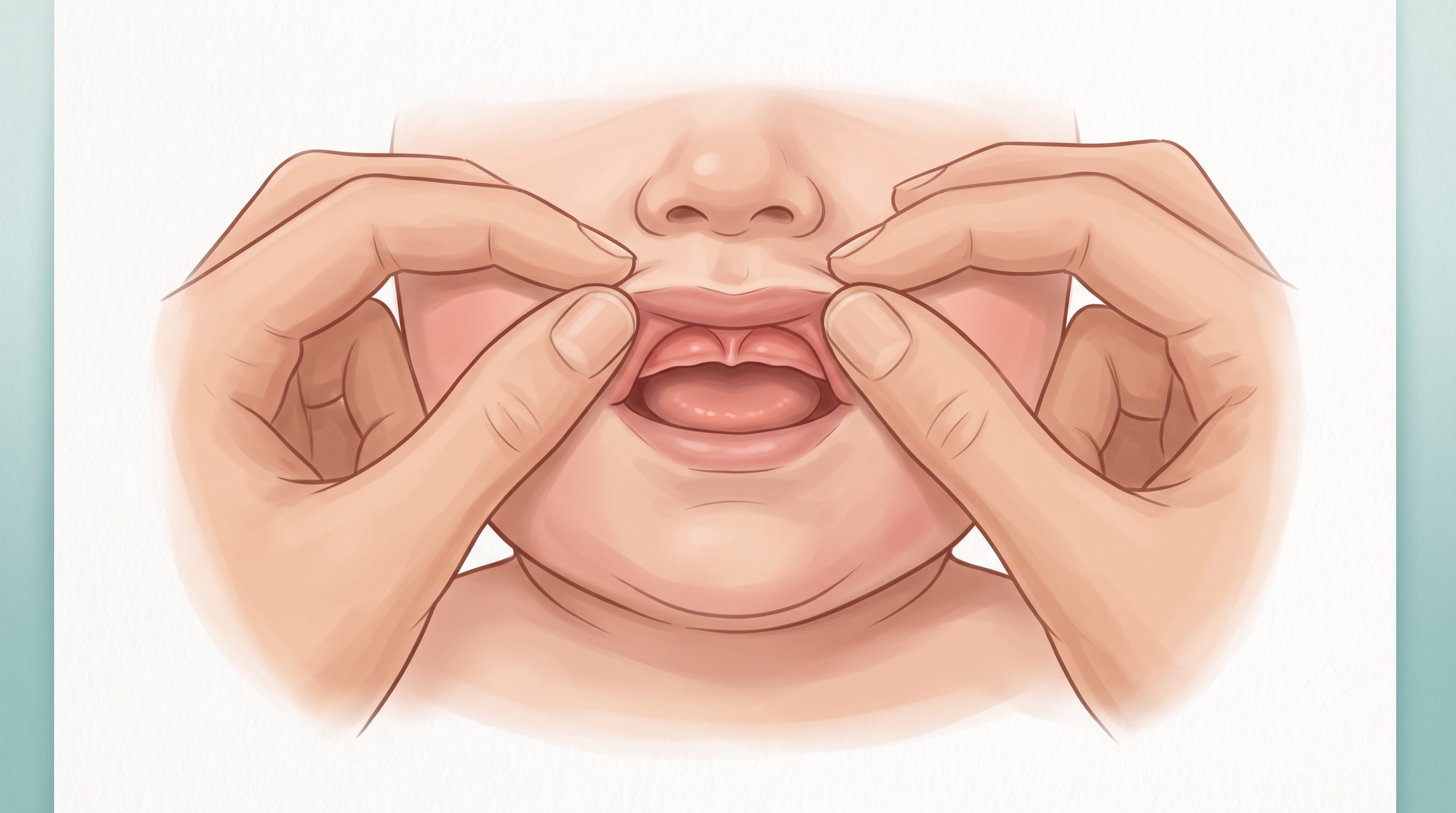
Lifting the upper lip is how the frenum is viewed during an evaluation — part of a functional assessment, not a substitute for one.
How a Baby Lip Tie Is Treated: Laser Labial Frenectomy
When a release is the right call, the treatment itself — a labial frenectomy — is brief. At Inspire Dental Wellness it’s performed with the LightScalpel CO2 laser, which allows a precise release with minimal bleeding and reduced tissue trauma compared with conventional approaches. The release itself typically takes only minutes, and many babies are able to feed right afterward, though every baby’s response is individual.
Afterward, healing support matters as much as the release. We walk parents through a short routine of gentle stretches of the healing area — taught in person at the visit, with a take-home handout — because keeping the released tissue mobile while it heals is the family’s part of the job, and consistent follow-through at home is a meaningful factor in how well the result holds. We’ll also schedule a follow-up to check healing, and when feeding work is ongoing, we keep the lactation consultant in the loop. You can read more about what aftercare involves, and the infant frenectomy page covers the full visit, step by step.
Feeding shouldn’t be a daily struggle — for your baby or for you. If the signs above feel familiar, an evaluation will give you a clear answer either way. See how we evaluate and release infant lip and tongue ties → or call (708) 460-6699 — our Orland Park office serves families from across the Chicago metro area.
Frequently Asked Questions About Baby Lip Ties
What is a lip tie?
A lip tie is a band of tissue (the labial frenum) connecting the upper lip to the gums that is tight or attached in a way that restricts how the lip moves. Everyone has a labial frenum — it only counts as a “tie” when it genuinely limits function, most noticeably a feeding baby’s ability to flange the upper lip and seal well on the breast or bottle.
What does a lip tie look like?
A typical labial frenum is a thin, elastic band attaching above the gumline, with the lip moving freely around it. A restrictive lip tie may look thick, broad, or tight, attach at or beyond the crest of the gum ridge, blanch when the lip moves, or keep the lip curled under during feeds. Appearance alone can’t confirm a lip tie, though — function and feeding history decide, which is why a clinical evaluation matters more than comparing photos.
How do I know if my baby has a lip tie?
Parents usually notice feeding signs first: a shallow or slipping latch, clicking sounds, milk leaking from the corners of the mouth, gassiness after feeds, long exhausting feeds, or nipple pain for a nursing mother. These signs have other possible causes too, so a clinical evaluation — looking at how the lip and tongue actually function — is the only way to know whether a lip tie is the contributing factor.
Can a lip tie cause a gap between my baby’s front teeth?
A low-attaching frenum is one possible contributor to a gap between the upper front teeth, but gaps between baby teeth are normal, and many close on their own as the permanent teeth come in. A gap alone is rarely a reason to release an infant’s lip tie — that’s a conversation better had at a later age if the gap persists.
Does every lip tie need to be released?
No. Many lip ties never cause problems and never need treatment. We recommend a release when the tie is genuinely restricting function — most often feeding in infancy — not preventively and not based on appearance alone.
Can a lip tie affect bottle-fed babies too?
Yes. The upper lip plays the same sealing role on a bottle nipple as it does at the breast, so a restrictive lip tie can show up as milk leaking, clicking, swallowed air, and gassy, unsettled feeds in bottle-fed babies as well.
How is a baby lip tie treated?
When a release is indicated, we perform a labial frenectomy using the LightScalpel CO2 laser. The release itself typically takes only minutes, with minimal bleeding and reduced tissue trauma, and many babies can feed right afterward. Parents are taught a short routine of gentle aftercare stretches at the visit, and a follow-up appointment checks healing.
Is a lip tie release covered by insurance?
Coverage varies by plan and by how the case is documented — frenectomy can fall under dental or medical benefits depending on the situation. Our team reviews your benefits before the appointment, handles the paperwork, and walks you through what to expect, so call us at (708) 460-6699 and we’ll help you sort it out.
If this was useful, you might also explore
Infant Frenectomy
Tongue-tie and lip-tie release for newborns and babies: signs, the evaluation, the release visit, and recovery.
How infant frenectomy works →Frenectomy & Tongue Tie Overview
The full picture across every age: infants, kids, and adults, and how a preparation-first philosophy shapes our approach.
Frenectomy overview →Meet Dr. Erica
Trained in functional frenuloplasty at The Breathe Institute; a provider who has been on the parent side of this experience too.
About Dr. Erica →