
Functional Orthodontics in Orland Park, IL
Airway-centered orthodontic care for kids and teens through age 15 — palate expansion, functional appliances, and self-ligating braces.
We are a general dental practice in Orland Park, IL — not a board-certified orthodontist’s office — and we’ll tell you when a specialist is the right referral.
Looking for clear aligners only (adults 16+)? See our Candid Clear Aligners page — this page is dedicated to functional and airway orthodontics for kids and teens.
Orland Park, IL · 14512 John Humphrey Drive · General dentistry practicing airway-centered orthodontics · Honest scope, every visit

What We Offer
Our orthodontic approach is built around your airway, your arch width, and the long-term shape of your face. What that looks like depends on your age. Here’s what we do, and who it’s for.
For Kids & Teens (Through Age 15)
Between roughly ages 3 and 15, the upper jaw is still developing. That window is when the most lasting work can be done — addressing airway habits early, widening the palate when needed, guiding jaw growth, and creating enough arch width for all 32 teeth (including wisdom teeth) to erupt naturally.
Care in this age range may include:
- Myobrace early intervention — a removable myofunctional appliance worn at night and a few hours during the day, paired with daily oral-posture and breathing exercises. For kids (typically ages 3–15) showing early signs of mouth breathing, low tongue posture, or swallowing patterns affecting arch development. With consistent use and family follow-through, Myobrace may decrease the likelihood that a child needs traditional braces later. Adherence is essential.
- Palate expansion — a fixed or removable appliance that gently widens the upper arch over several months. Often the first phase of structural treatment.
- Functional appliances — devices that guide how the upper and lower jaws relate as a child grows.
- Self-ligating braces — used to align teeth into the expanded arch, or as a standalone phase for kids who don’t need expansion. Self-ligating brackets use a sliding clip rather than elastic ties, which tends to mean less friction and fewer adjustment visits.
Whether a child starts with Myobrace, expansion, brackets, or some combination depends on the case. Dr. Erica will walk you through the plan at the consultation.
Parents sometimes search for “interceptive orthodontics” or “early orthodontics” — the general term for treatment that starts while the jaws are still growing, before all the adult teeth are in. That is what the care above is: interceptive, airway-focused orthodontics for kids and teens, with the goal of creating room rather than removing teeth later. And if you have been looking for an “airway orthodontist,” a note on scope: Inspire Dental Wellness is a general dental practice, not an orthodontic specialty office. Dr. Erica provides airway-centered functional orthodontics within that scope and refers to board-certified orthodontists when a case calls for one.
Schedule a Kids/Teen ConsultationFor Adults (16+)
Once a patient is 16 or older, Dr. Erica’s approach shifts. For adults, we offer Candid Clear Aligners — a series of custom-molded clear trays that gradually move teeth into alignment over 6 to 18 months (timing varies by case).
Candid is a good fit for adults who:
- Want to correct crowding, spacing, or minor bite issues
- Prefer a nearly-invisible appliance over brackets and wires
- Can commit to wearing aligners 20–22 hours a day
Candid is not a fit for every adult case. If your situation calls for brackets and wires, palate expansion, oral surgery, or full orthognathic work, we’ll tell you and refer you to a trusted local orthodontist or oral surgeon.
Schedule an Adult Candid ConsultationComfort-Focused Orthodontics: The MLS Laser
Orthodontic tooth movement can bring soreness — most often in the day or two after an adjustment. As part of orthodontic care, Dr. Erica uses the MLS (Multiwave Locked System) laser, a therapeutic device that delivers photobiomodulation (PBM) — gentle, low-level therapeutic light applied to the tissues around the teeth. Research on photobiomodulation in orthodontics suggests it may help ease the discomfort that can follow adjustments, and some studies suggest it may support the rate of tooth movement. The evidence is still emerging and responses vary from person to person, so we use it as a supportive, comfort-focused part of treatment — not a guarantee of less pain or a shorter timeline. Whether it’s a fit for your case is something we’ll talk through at your consultation. Learn more about our MLS laser →
Why We Focus on Expansion and Arch Width
At Inspire Dental Wellness, orthodontic care isn’t about straight teeth in isolation. It’s about the space those teeth live in — the arch, the palate, and everything connected to them.
The upper palate is also the floor of the nasal cavity. When the palate is narrow, the nasal airway tends to be narrow. When the arch doesn’t have room for all 32 teeth, something has to give — teeth crowd, erupt sideways, or get removed to make space. And when teeth get removed to make space, the tongue has less room, which can affect how it rests, how a patient swallows, and how they breathe at night.
Dr. Erica’s approach works in the other direction. By widening the arch early — while a child is still growing — there’s room for the teeth that nature intended, room for the tongue, and a more developed airway. It’s why palate expansion is the starting point for many of our kid and teen cases, not the exception.
For younger kids — sometimes as early as ages 3 or 4 — when mouth breathing, tongue posture, and swallowing habits are already shaping how the arch is developing, we start even earlier with Myobrace. With consistent use and daily exercises over time, this kind of early myofunctional work may decrease the likelihood that more structural orthodontics is needed later.
This philosophy comes from her training under Dr. Ed Lipskis at the Centre for Integrative Orthodontics, who has been teaching airway-focused orthodontic care to dentists in the Chicago area for years.
Read more about how this fits into our broader airway-centered approach on our airway dentistry pillar page.
A Look at One Patient’s Course of Care (Ages 9–11)
This is what airway-focused orthodontic growth guidance can look like over a two-year course of care, in one of Dr. Erica’s pediatric patients. Care began at age 9 and completed at age 11 — squarely inside the window the American Association of Orthodontists (AAO) describes as the right time for an orthodontic evaluation. The patient’s family consented to share these images so other parents can see what the philosophy in the prior section looks like in practice. One patient’s response to one treatment plan is not a guarantee of any other patient’s outcome — every case starts with a different airway, a different arch, and a different growth pattern. What follows is a description of what we measured, not a promise of what we deliver.
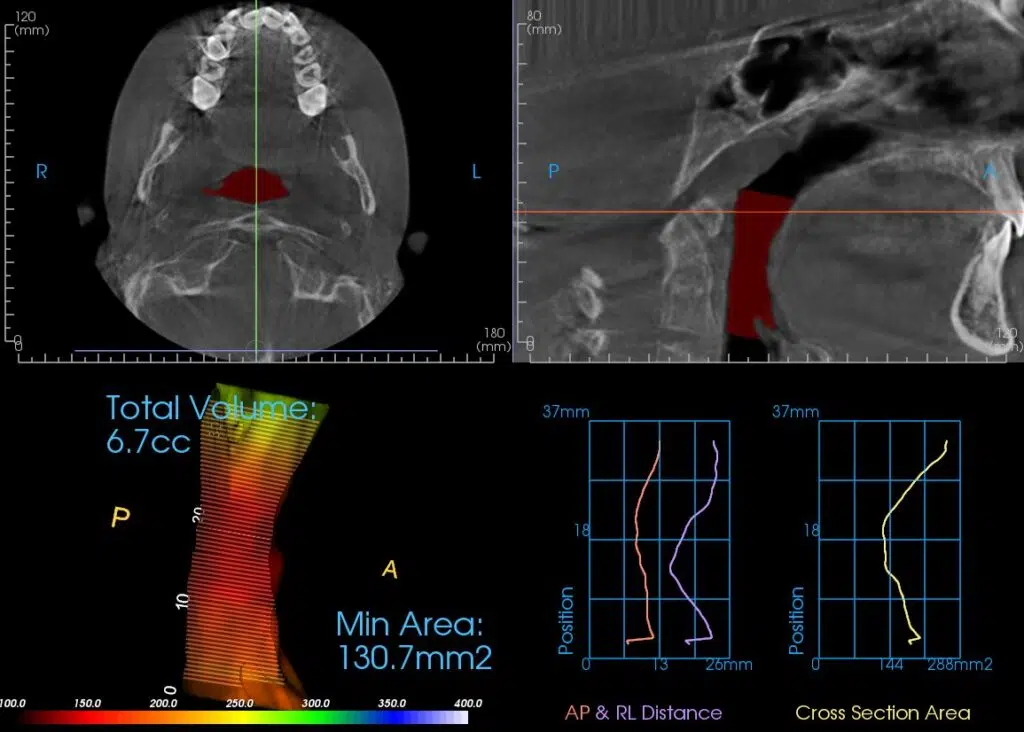
Image 1: Color-mapped CBCT airway volume rendering — measured airway volume 6.7 cc; minimum cross-sectional area 130.7 mm²
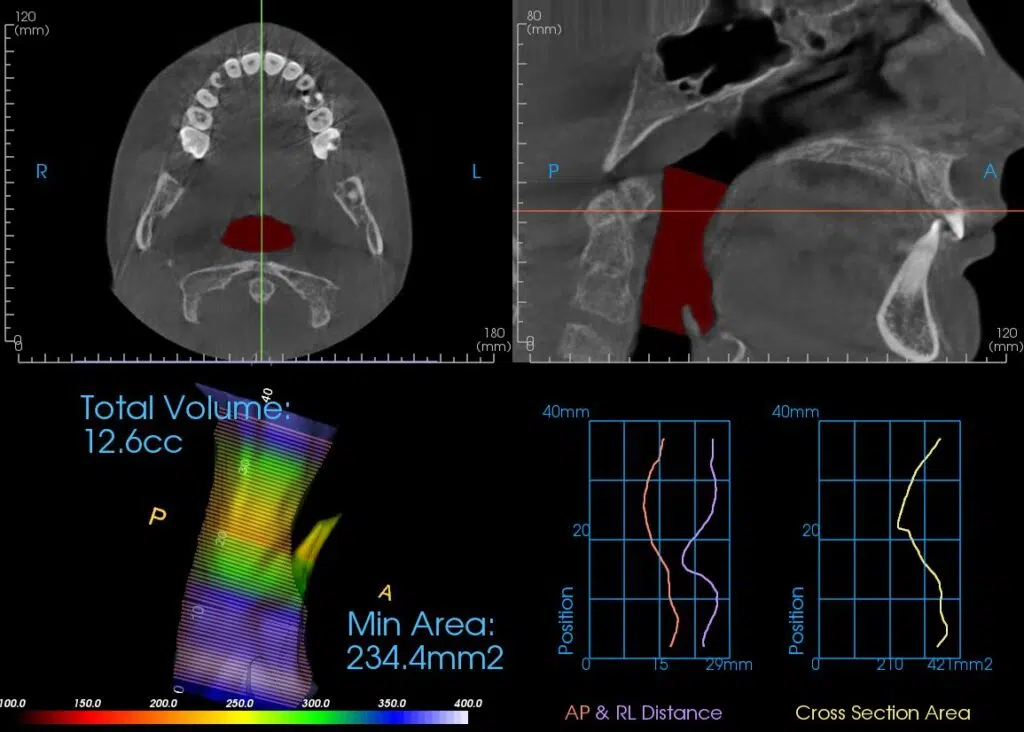
Image 2: Color-mapped CBCT airway volume rendering — measured airway volume 12.6 cc; minimum cross-sectional area 234.4 mm²

Image 3: Lateral cephalometric CBCT showing pretreatment skeletal posture and chin position

Image 4: Lateral cephalometric CBCT showing post-treatment skeletal posture and chin position
Images shown with parent/guardian consent. Patient began care at age 9 and completed care at age 11. Volumetric airway measurements (6.7 cc → 12.6 cc) and minimum cross-sectional area (130.7 mm² → 234.4 mm²) were taken from CBCT scans rendered in volumetric airway analysis software. Lateral cephalometric images show changes in skeletal posture and mandibular position over the same period.
In this case, the airway-focused plan combined palate expansion, functional appliance use during a growth window, and ongoing evaluation across two years. The CBCT volumetric measurements compared the same anatomical landmarks at the same imaging settings before and after care.
What we describe in the images is what was measured — airway volume and minimum cross-sectional area as visualized in the volumetric rendering, and changes in skeletal posture and mandibular position visible on the lateral cephalometric scans. We are not making a claim about how the patient sleeps, how they breathe through the day, or what their long-term respiratory health will be. We are showing what the imaging recorded over the course of care.
This is one patient. Other patients have started with different anatomy, different growth potential, and different treatment plans. Individual outcomes vary. This case demonstrates one patient’s response to airway-focused orthodontic growth guidance during the 9–11 growth window. Results depend on individual anatomy, treatment plan, growth, and adherence.
The AAO recommends a child’s first orthodontic evaluation by age 7. This case is one example of why that recommendation exists: the earlier a developing arch can be evaluated, the more options stay open while growth is still working in the patient’s favor.
Dr. Erica’s Philosophy on Wisdom Teeth
Dr. Erica believes wisdom teeth are a functioning part of your smile, your facial structure, and everyday actions like eating and speaking. In her clinical philosophy, wisdom teeth also help shape the face as it develops — supporting natural width, forward jaw positioning, and the proportions that align with facial symmetry.
In most cases she evaluates, patients have room in the arch for their wisdom teeth. When they do, she monitors and preserves them rather than recommending removal by default. When removal is clinically necessary, she coordinates with trusted oral surgery partners.
This philosophy is one of the reasons Dr. Erica practices expansion-based orthodontics for kids and teens — creating the arch width early so wisdom teeth have room to erupt naturally.
Meet Dr. Erica
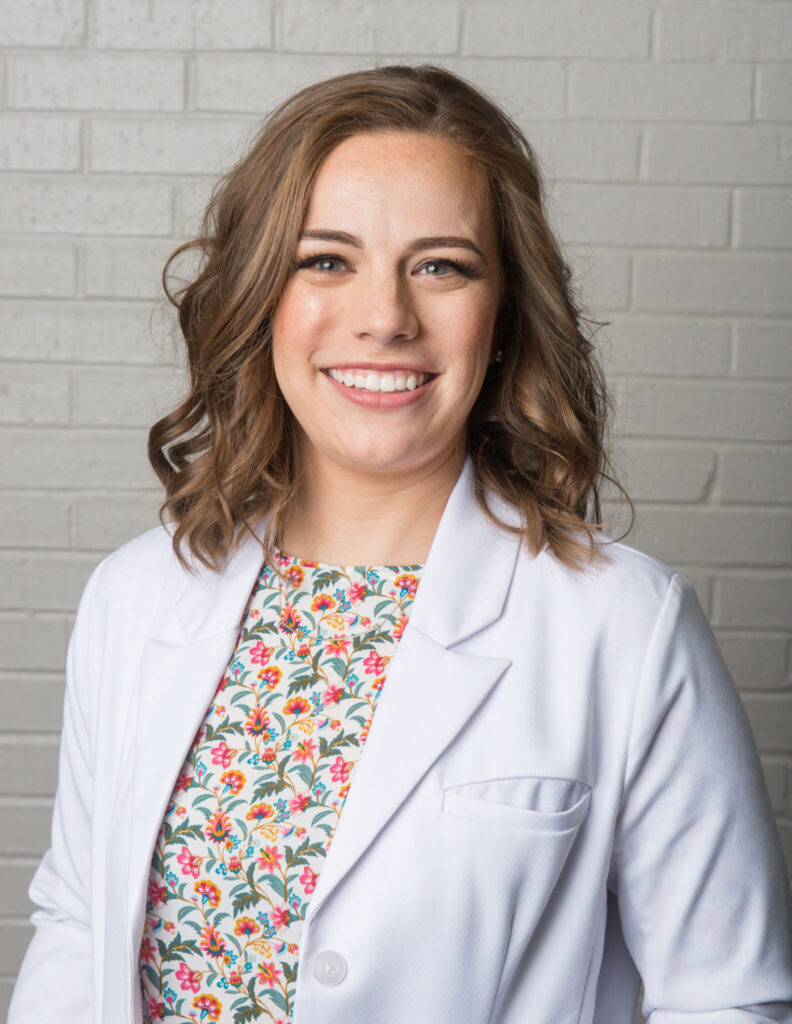
I’m Dr. Erica Zolnierczyk, and I practice a different kind of orthodontic care. I’m a general dentist, not a board-certified orthodontist — and I’ll be upfront about that every step of the way. What I offer is airway-centered functional orthodontics, within the scope of my dental license and the training I’ve done under Dr. Ed Lipskis at the Centre for Integrative Orthodontics.
The way I practice is shaped by a simple conviction: the goal of ortho isn’t just straight teeth. It’s enough room in the arch for all your teeth, a palate that supports your airway, and a face that develops the way nature intended. When I meet a kid at age 7 whose palate is narrow, I don’t want to wait until age 14 and pull teeth to fix the crowding. I want to make the room now. For some kids — especially when mouth breathing and tongue posture are already part of the picture — that work starts even earlier with Myobrace, before structural orthodontics is needed at all.
That’s why I’ve narrowed my orthodontic focus to kids and teens up through age 15 — that’s where my expansion, functional appliance, and brackets-and-wires care lives. For adult patients, I offer Candid Clear Aligners to align what’s there. I know adult expansion is possible — I’ve been through it myself with Dr. Lipskis, and so has my husband. It’s simply not the lane I’m practicing in, so if you’re an adult who wants a functional-orthodontics provider for expansion work, I’ll refer you to one I trust.
The word inspire comes from the Latin inspirare — literally, to breathe. That’s why the practice is called what it’s called, and it’s why ortho at Inspire Dental Wellness looks the way it does.
What We Do — and What We Don’t
What We Do
- Myobrace early intervention for kids (typically ages 3–15)
- Palate expansion for kids and teens (through age 15)
- Functional appliances for growing jaws
- Self-ligating braces for kids and teens
- Candid Clear Aligners for adults (16+)
- Wisdom tooth monitoring and preservation when the arch has the room
- Coordination with trusted oral surgery partners when extraction is clinically necessary
- Coordination with myofunctional therapists, ENTs, and sleep physicians when airway care is multi-disciplinary
What We Refer Out For
- Board-certified orthodontist consultations
- Adult palate expansion (MARPE, SARPE, or surgical expansion)
- Adult brackets-and-wires ortho
- Traditional extraction-based ortho
- Orthognathic (jaw) surgery
- Wisdom tooth extraction
If your situation calls for a board-certified orthodontist, adult brackets, or surgical expansion, we’ll tell you directly and refer you to trusted local orthodontists. Honest scope is a feature, not a limitation.
What to Expect at Your Consultation
- Airway and arch evaluation We look at your palate, your arch width, your bite, and — for kids — how the jaws are relating to each other as they grow. Many patients have a cone-beam CT scan for 3D imaging.
- Treatment-planning conversation Dr. Erica walks through what she sees, what the options are, what’s in scope at IDW, and what would be better referred out. If we’re not the right fit, we’ll say so.
- Written treatment plan You leave with a clear, written plan of what’s being recommended, the expected timeline, and what happens at each phase. Pricing is discussed in this conversation; it’s not published online because every case is different.
- Starting care For most expansion cases, treatment starts roughly 2–4 weeks after the consult. For Candid, impressions are taken at the consult visit or shortly after, and aligners typically arrive 3–4 weeks later. These are approximations — exact timing can vary depending on lab turnaround, appliance design, and scheduling, and we’ll give you a specific timeline for your case at the consultation.
Is This Right For You?
This Is a Good Fit If You
- Have a child aged ~6–15 and you’re thinking about ortho, braces, or expansion
- Have been told your child’s palate is narrow, or they’re mouth-breathing, or there isn’t room for all the adult teeth
- Are an adult who wants Candid Clear Aligners and doesn’t want brackets
- Want an orthodontic approach integrated with airway, breathing, and overall oral health — not just straightening the teeth you can see when you smile
- Are comfortable being told when something is out of our scope
This Isn’t the Right Fit If You
- Want traditional brackets-and-wires as an adult — we don’t offer that and we’ll refer you
- Want a board-certified orthodontist’s perspective — we can refer you to one
- Are looking for the cheapest option — our approach is premium and we don’t compete on price
- Want a guarantee of outcome — no ethical practitioner can give you one, and we won’t pretend otherwise
Insurance & Financing
Inspire Dental Wellness is independently owned and operated — Dr. Erica’s practice, where treatment plans are built around what your case actually needs, not around what a dental plan will or won’t approve. We run a concierge, fee-for-service model. Most families still use their dental benefits to offset part of orthodontic care, and our team will review your benefits with you ahead of the visit, prepare the documentation, and handle the paperwork — any reimbursement from your plan comes directly back to you.
For patients who prefer third-party financing, we partner with CareCredit, a healthcare financing company that offers 6–24 month payment plans for qualifying applicants.
Detailed pricing — and the payment options that fit your specific case — is discussed at your consultation, where Dr. Erica can tailor a plan to what you actually need.
Orthodontic Care in Orland Park and the South Suburbs
We serve patients from across the Chicago south suburbs, including Orland Park, Tinley Park, Palos Heights, Palos Park, Homer Glen, Oak Forest, Orland Hills, Frankfort and Mokena. Our office is at 14512 John Humphrey Drive, Orland Park, IL 60462.
Office hours: Mon 8–5 · Tue–Thu 7–3
Frequently Asked Questions
Is Inspire Dental Wellness an orthodontist’s office?
No. We are a general dental practice, and Dr. Erica Zolnierczyk is a licensed general dentist — not a board-certified orthodontist. We offer airway-centered orthodontic care within the scope of general dental practice, specifically: Myobrace early intervention, palate expansion, functional appliances, and self-ligating braces for kids and teens through age 15, and Candid Clear Aligners for adults 16 and older. If your case requires a board-certified orthodontist, we’ll say so and refer you.
Do you do braces for adults?
No. Dr. Erica stopped offering brackets-and-wires to adult patients. For adults 16 and older, our orthodontic option is Candid Clear Aligners. If you specifically want traditional braces, we can refer you to a trusted local orthodontist.
What is palate expansion and why do you recommend it?
Palate expansion is a treatment that gently widens the upper jaw using a fixed or removable appliance over several months. It works most effectively while a child’s upper jaw is still developing — roughly ages 6 through 15. Dr. Erica recommends it when a child’s arch is too narrow to accommodate all 32 adult teeth, or when airway concerns are involved. Widening the palate creates more room for teeth, more room for the tongue, and a more developed upper airway.
What is Myobrace, and could it help my child avoid braces later?
Myobrace is a system of removable myofunctional appliances worn at night and a few hours during the day, paired with daily oral-posture and breathing exercises. It’s designed for kids — typically ages 3–15 — who show early signs of airway-related habits like mouth breathing, low tongue posture, or swallowing patterns affecting how the arch is developing. The goal is to address those upstream patterns before they push the bite or jaw into a place where structural orthodontics becomes the only option. With consistent use and family follow-through, Myobrace may decrease the likelihood that a child needs traditional braces later. It’s not a passive treatment — adherence to the daily exercises and wear schedule is essential, and outcomes vary by case.
Do you use Invisalign?
No. We use Candid Clear Aligners for our adult orthodontic cases. Candid Clear Aligners is a clinically comparable clear aligner system and is the brand we’ve standardized on.
What are self-ligating braces?
Self-ligating braces are a type of bracket that uses a sliding clip to hold the archwire in place, instead of the traditional elastic ties you may have seen before. They tend to have less friction, and many patients experience fewer adjustment appointments over the course of treatment. We use them for kids and teens through age 15.
At what age should my child have their first orthodontic evaluation?
The American Association of Orthodontists recommends a first orthodontic evaluation by age 7. That doesn’t mean treatment starts at 7 — it means a dentist or orthodontist should take a look at the developing jaw and bite so that if intervention is going to help, it happens in the window when it can do the most good. The age 9–11 case study above is an example of growth-window care that began near that AAO-recommended evaluation age. For kids with airway-related habits, intervention can sometimes start even earlier with Myobrace.
Do I have to have my wisdom teeth removed?
Not necessarily. Dr. Erica’s clinical philosophy is that wisdom teeth are a functional part of your smile and facial structure, and in most cases she evaluates, patients have the arch width to preserve them. She monitors wisdom teeth during routine care and recommends removal only when it’s clinically necessary — at which point she coordinates with trusted oral surgery partners.
Can you treat my child if they’re older than 15?
We generally accept new orthodontic patients up to age 15 for our expansion, functional appliance, and brackets-and-wires care — that gives us enough runway to complete treatment during their growing years, before adulthood shifts what’s possible. Patients 16 and older are candidates for Candid Clear Aligners. If your teenager is close to the cutoff, the best next step is a consultation so we can evaluate their case specifically.
How much does orthodontic treatment cost?
Pricing depends on the specific case — what we’re addressing, the appliances involved, and the expected length of care. We don’t publish a fee schedule because every case is different. We discuss pricing and payment options in detail at your consultation, after Dr. Erica has built a treatment plan tailored to your situation.
How do I get started?
Schedule a consultation. Call us at (708) 460-6699 or use the contact form. At the consultation, Dr. Erica evaluates the case, discusses what’s in scope and what isn’t, and provides a written treatment plan with timeline and pricing.
Does the MLS laser make braces or aligners less uncomfortable?
It may help. The MLS laser delivers photobiomodulation — gentle therapeutic light — and research suggests this can reduce the soreness some people feel after orthodontic adjustments. Responses vary, and it’s one of several comfort measures we use. Dr. Erica will discuss whether it’s appropriate for your treatment.
Can the MLS laser speed up my orthodontic treatment?
Some studies suggest photobiomodulation may support a faster rate of tooth movement, but the research is still emerging and the effect varies. We don’t promise a shorter treatment time — your timeline depends on your individual case. We use the laser primarily for comfort, with any effect on tooth movement as a possible added benefit.
Ready to Start? Let’s Talk About Your Case.
Whether you’re thinking about expansion for a 9-year-old, Myobrace for a 5-year-old, or Candid Clear Aligners for yourself, the first step is a consultation. We’ll evaluate the case and tell you honestly whether we’re the right fit — and refer you out if we’re not.
Dr. Erica Zolnierczyk, DMD · Trained in airway-focused orthodontics under Dr. Ed Lipskis · 14512 John Humphrey Drive, Orland Park, IL 60462
Inspire Dental Wellness is a general dental practice. Dr. Erica Zolnierczyk is a licensed general dentist in the state of Illinois practicing airway-centered orthodontic care within the scope of general dentistry. She is not a board-certified orthodontist.